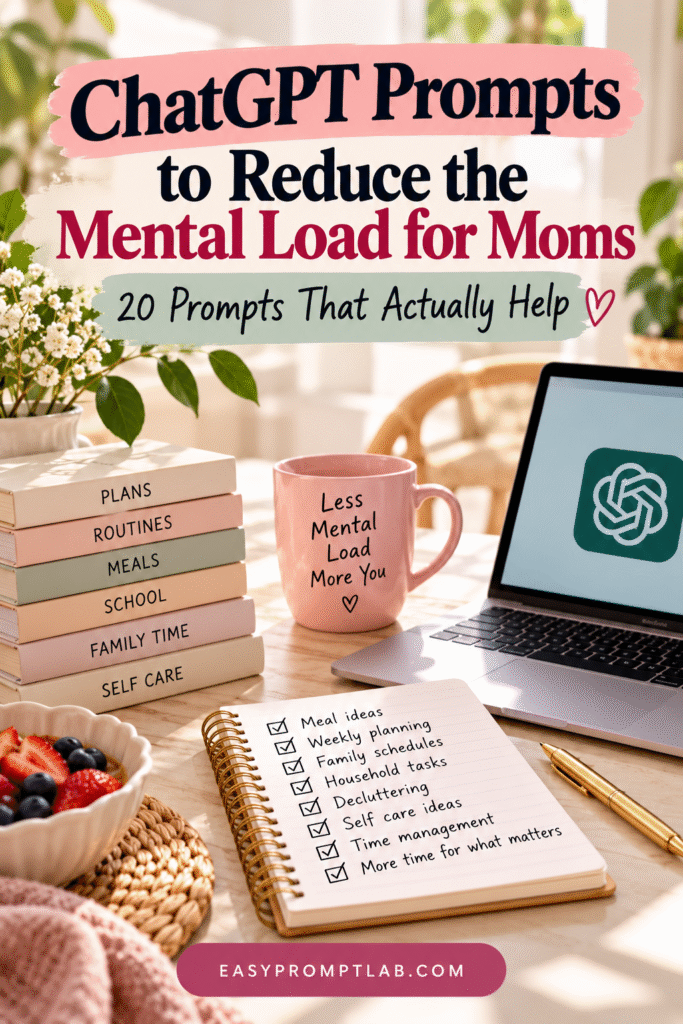
ChatGPT Prompts to Reduce the Mental Load for Moms | 20 Prompts That Actually Help
The exhausting part of family life isn’t always doing the tasks.
Sometimes it’s remembering all of them.
READ: 10 Powerful AI Prompts That Help You Stop Overthinking, Get Motivated & Get Things Done
The school form that needs signing. The birthday present you haven’t bought. The dentist appointment that needs rescheduling. The dinner ingredients that need using. The uniform that’s suddenly too small. The mental note to check whether Friday is non-uniform day.
None of those jobs is enormous on its own.
The problem is that they all live in your head at the same time.
READ: AI Prompts for Busy Parents: Meal Planning, School Admin, Chores and Family Life
ChatGPT won’t remove the actual responsibilities of family life, and it certainly shouldn’t become the person making important parenting decisions for you But it can be useful for something much simpler:
getting information out of your head and turning it into a plan.

The prompts below are designed to help with exactly that.
They cover brain dumps, family admin, meals, school logistics, household responsibilities, appointments, recurring tasks, decision fatigue and weekly planning.
OpenAI’s current prompting guidance recommends being clear and specific, giving ChatGPT the context it needs and refining the response when necessary rather than expecting one vague prompt to produce a perfect result.
That is particularly useful here because your family life is specific.
Your useful prompt is rarely:
Organise my life.
It is more likely:
Here are the 23 things currently taking up space in my brain. Sort them into what needs doing today, this week, later and not at all.
Much better.
What does “mental load” actually mean?
Mental load is the ongoing work of remembering, anticipating, planning and coordinating what a household or family needs.
It can include:
- remembering appointments;
- planning meals;
- keeping track of school dates;
- noticing when household supplies are running low;
- buying presents;
- arranging childcare;
- keeping track of bills;
- remembering clothing sizes;
- anticipating upcoming events;
- noticing jobs before anyone else notices they need doing.
That planning work can exist even when someone else performs the actual task.
Current Pew Research Center research on working parents in the US found that work and family responsibilities regularly overlap, with 54% of full-time working parents saying balancing the two is difficult. The report also specifically notes the mental load mothers often carry while trying to coordinate family needs with work.
ChatGPT won’t fix an unfair division of labour.
But it can help make invisible work visible, organised and easier to hand over.
Start with this mental-load brain-dump prompt
If you use only one prompt from this article, start here.
I need help getting the mental load of family life out of my head.
Here is everything I am currently remembering, worrying about, planning or trying not to forget:
[PASTE EVERYTHING]
Organise it into:
- needs attention today;
- needs attention this week;
- schedule for later;
- recurring responsibility;
- someone else could own this;
- probably doesn’t need doing.
Identify deadlines or missing information.
Do not invent deadlines or commitments I haven’t provided.
Then give me only the five most useful next actions.
That final sentence matters.
You do not need ChatGPT to transform your 28-item mental load into a beautifully categorised 47-item productivity system.
You need fewer things in your head.

1. Sort an overwhelming family to-do list
Use this when everything feels equally urgent.
Here is my current family to-do list:
[PASTE LIST]
Sort it by:
Urgent and important
Important but not urgent
Quick tasks under 10 minutes
Can be delegated
Can wait
Can probably be droppedConsider any deadlines I have included.
Do not assume everything needs to be completed.
End with the three tasks I should deal with first.
Why this works
One source of mental overload is treating every open loop as though it deserves immediate attention.
This prompt forces a distinction between:
needs doing
and:
is currently taking up space in my head.
Those are not always the same thing.
2. Create one weekly family command centre
Instead of keeping meals in one note, school information in an email and appointments somewhere in the depths of your phone, ask ChatGPT to organise the week into one view.
Create one weekly family overview from the information below:
[PASTE APPOINTMENTS, SCHOOL EVENTS, WORK COMMITMENTS, ACTIVITIES, DEADLINES AND MEAL NOTES]
Organise it Monday to Sunday.
For each day include:
- appointments;
- work/school commitments;
- children’s activities;
- dinner;
- items that need preparing beforehand;
- anything that needs bringing;
- deadlines.
Highlight any obvious clashes or unusually busy days.
Do not invent travel times or missing details.

3. Work out what needs preparing the night before
Morning stress often starts the evening before.
Here is tomorrow’s family schedule:
[PASTE SCHEDULE]
Create a short evening preparation checklist.
Include only things that will make tomorrow morning easier.
Consider:
- bags;
- school items;
- work items;
- lunches;
- clothing;
- equipment;
- paperwork;
- appointments;
- transport.
Keep the checklist to a maximum of 10 items.
Put the highest-impact tasks first.
4. Turn school messages into actions
School communication is particularly good at arriving through six channels simultaneously.
Use ChatGPT to extract what you actually need to do.
Below are messages or notices from school:
[PASTE TEXT]
Extract only the information that requires action from me.
Create a table with:
Action
Child
Deadline/date
What I need to prepare/buy/sendThen separately list information that is useful to know but requires no action.
Do not invent dates or requirements.
Be cautious about pasting children’s full names, contact information or other unnecessary personal information into any AI service.
You can replace them with:
Child A
and:
Child B
for most planning tasks.
5. Create a school-term master list
Here are all the school dates and commitments I currently know about:
[PASTE INFORMATION]
Organise them chronologically.
Categorise each as:
- school closure;
- event;
- payment;
- clothing/equipment needed;
- parent action;
- appointment;
- deadline.
Create a “prepare ahead” date for anything that requires buying, booking or organising.
Do not invent dates if one is missing.
6. Reduce the “what’s for dinner?” decision
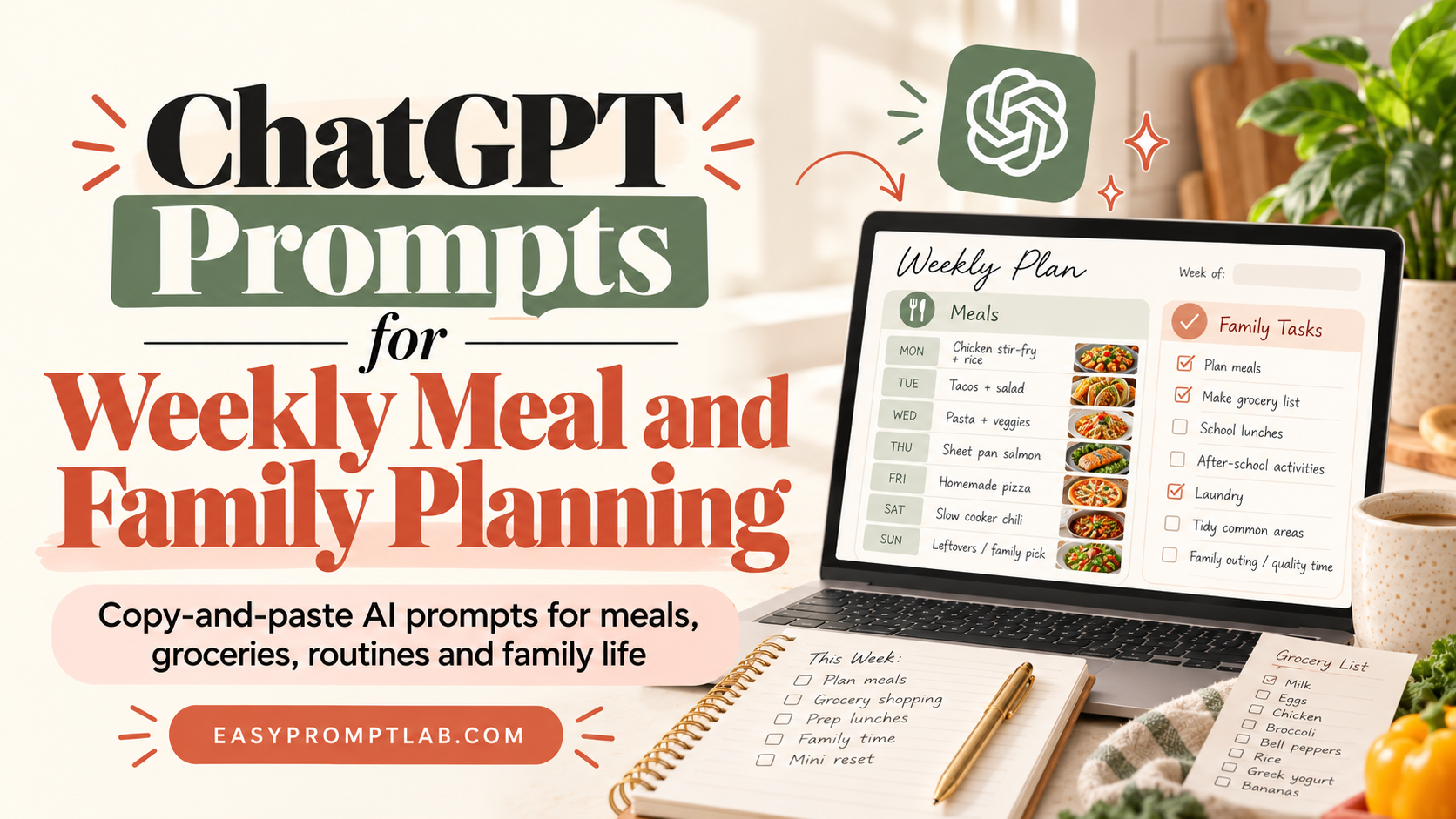
Meal planning is already covered more deeply in my weekly meal-planning guide but one simple prompt can remove a recurring daily decision.
Plan five realistic weekday dinners for my family.
Family size:
[NUMBER]Foods we like:
[LIST]Foods we don’t eat:
[LIST]Ingredients already at home:
[LIST]Busy evenings:
[DAYS]Maximum active cooking time:
[TIME]Reuse ingredients where sensible.
Include at least one leftovers night and one emergency easy meal.
Do not create five completely unrelated ingredient lists.
7. Turn the meal plan into one shopping list
Here is this week’s meal plan:
[PASTE]
Here is what I already have:
[PASTE]
Create one grocery list containing only what I still need.
Group it by supermarket section.
Combine ingredients used across several meals.
Flag anything where you cannot confidently determine the required quantity.
8. Create a list of “default” family decisions
Sometimes the problem isn’t the size of the decision.
It’s making the same decision over and over again.
Help me create sensible defaults for recurring family decisions.
The decisions I repeatedly make include:
[EXAMPLES: lunches, Friday dinner, weekend activity, laundry days, birthday gifts, school-night routine]
Suggest a simple default for each.
The goal is to reduce unnecessary weekly decision-making, not create a rigid schedule.
Identify which decisions should remain flexible.
For example:
Friday dinner: pizza or freezer meal.
That may not make anyone’s lifestyle magazine.
It does, however, mean you no longer have to decide what’s for dinner every Friday at 5:47pm.
9. Create a recurring household checklist
These are household tasks I regularly need to remember:
[PASTE LIST]
Organise them by frequency:
- daily;
- weekly;
- fortnightly;
- monthly;
- seasonal;
- occasional.
Identify tasks that could be grouped together.
Keep the system as simple as possible.
10. Find things someone else could fully own
There is a difference between:
Can you help me with this?
and:
This is now your responsibility from start to finish.
Use this prompt to make ownership more visible.
Here are the recurring responsibilities I currently manage:
[LIST]
Help me identify tasks that could be transferred completely to another adult or age-appropriate family member.
For each task explain:
- what full ownership involves;
- what information they would need;
- whether the task is recurring;
- what I would need to stop monitoring for it to genuinely leave my mental load.
Do not assume who should take each responsibility.
The purpose isn’t to ask AI to determine what is “fair.”
It is to identify what full ownership actually includes.
For example, “children’s dentist appointments” might mean:
- remembering when one is due;
- booking it;
- putting it in the calendar;
- rearranging conflicts;
- taking the child;
- organising follow-up.
The invisible work is often hidden inside the job title.
11. Build a fairer household responsibility conversation
ChatGPT can also help you organise what you want to say before a conversation.
Help me prepare for a calm conversation about household and family responsibilities.
Current situation:
[EXPLAIN]
Responsibilities I currently manage:
[LIST]
What feels difficult:
[EXPLAIN]
Changes I would like:
[EXPLAIN]
Help me organise the conversation around:
- specific responsibilities;
- ownership rather than “helping”;
- practical changes;
- what success would look like.
Avoid accusatory language.
Do not minimise the issue.
12. Create a family admin hour
I want to set aside one hour each week for family admin.
These are the types of tasks I usually deal with:
[LIST]
Create a reusable 60-minute routine.
Put the highest-impact jobs first.
Include:
- calendar;
- school;
- appointments;
- bills/forms;
- shopping/planning;
- upcoming events.
Keep the routine realistic.
Do not try to fit every household task into this hour.
13. Turn a messy notes app into a plan
If your phone contains notes called:
school stuff
things to buy
remember!!!
this prompt is for you.
Below are several messy notes containing family reminders:
[PASTE NOTES]
Combine them into one clean list.
Remove duplicates.
Categorise items by:
- calendar;
- shopping;
- school;
- household;
- appointments;
- people to contact;
- future ideas.
Flag any item whose meaning is unclear rather than guessing.
14. Plan birthdays without remembering everything manually
Help me plan an upcoming birthday.
Person/age:
[DETAIL]Date:
[DATE]Plans:
[DETAIL]Budget:
[BUDGET]Create a timeline covering:
- invitations;
- venue/home setup;
- food;
- cake;
- presents;
- decorations;
- clothing;
- transport;
- thank-you messages if relevant.
Show what needs doing:
3–4 weeks before
1–2 weeks before
week of
day before
day ofRemove anything that does not apply to the plan I’ve described.
15. Create a packing list without mentally rehearsing the trip 27 times
Create a family packing list for:
[DESTINATION/TRIP]
People travelling:
[DETAILS]
Length:
[DAYS]
Weather:
[IF KNOWN]
Activities:
[LIST]
Accommodation includes:
[DETAILS]
Organise the list by person and category.
Separate:
Pack ahead
Pack on departure day
Documents/important itemsAvoid adding unnecessary “just in case” items.
16. Organise medical and appointment admin
ChatGPT can help with administration around healthcare, but it should not be used to diagnose family members or replace professional advice.
Help me organise these family appointments:
[PASTE DATES / APPOINTMENTS / ADMIN]
Create a simple list showing:
- person;
- appointment;
- date/time;
- location;
- anything I need to bring;
- questions I have already noted;
- follow-up required.
Use only the information I provide.
Do not give medical advice.
17. Make a “things we’re running out of” system
Help me create a simple restocking checklist for our household.
Common items we run out of include:
[LIST]
Group them into:
- food;
- toiletries;
- cleaning;
- school;
- household;
- other.
Identify which items are sensible to keep one spare of.
Keep the system simple enough to maintain.
18. Reduce weekend planning decisions
Give me five realistic weekend options for my family based on:
Children/ages:
[DETAIL]Budget:
[BUDGET]Weather:
[DETAIL]Available time:
[TIME]Energy level:
[LOW / MEDIUM / HIGH]Travel limit:
[DISTANCE]Give:
- one stay-home option;
- one free/low-cost option;
- one outdoor option;
- one easy outing;
- one slightly bigger plan.
Do not invent local opening times or prices.
19. Decide what doesn’t need doing this week
This prompt is underrated.
Here is everything I think I need to do this week:
[LIST]
My genuinely important commitments are:
[LIST]
Help me identify:
- tasks that can move to next week;
- tasks that can be simplified;
- tasks that can be delegated;
- tasks that don’t appear necessary;
- tasks with real deadlines.
Do not assume productivity is the goal.
The goal is to create a realistic week.
Sometimes the useful answer isn’t:
Here’s how to fit everything in.
It is:
You don’t need to do all of this.
20. Run a Sunday mental-load reset
Use this once a week.
Help me do a 15-minute Sunday family reset.
Next week’s commitments:
[PASTE]
Things currently on my mind:
[PASTE]
Food already at home:
[PASTE]
Things I must not forget:
[PASTE]
Create:
- the five most important family tasks;
- the week’s appointments and deadlines;
- five dinners;
- one shopping list;
- night-before preparation reminders;
- tasks someone else could own;
- anything that can safely wait.
Keep the result concise enough to use during the week.
The point isn’t to become more productive
This is where a lot of “AI for moms” advice goes wrong.
Reducing mental load shouldn’t mean:
Great, now you’ve saved 45 minutes. Here are nine additional things to accomplish.
The useful goal is less cognitive clutter.
That might mean:
- fewer decisions;
- fewer reminders;
- clearer ownership;
- one list instead of five;
- repeating meals;
- default routines;
- deciding something can wait.
ChatGPT is particularly useful when the information already exists but is scattered.
Give it the mess.
Ask it to structure the mess.
Then stop.
Use ChatGPT to externalise, not supervise
There’s also a trap here.
You can create an extremely sophisticated ChatGPT-powered household-management system and then accidentally give yourself another system that requires constant maintenance.
That rather defeats the point.
Keep what genuinely reduces work.
A useful rule is:
If maintaining the system takes longer than remembering the task, simplify the system.
Tell ChatGPT your actual constraints
Compare:
Create a weekly schedule for my family.
with:
I work Monday to Thursday, do school drop-off at 8:30, have two activities on Wednesday evening and don’t want to schedule household jobs after 8pm. Build a realistic plan around that.
The second prompt is much more useful because it describes reality.
OpenAI recommends giving enough context for the model to understand the task and then refining the output when the first response doesn’t quite fit.
Useful constraints include:
- budget;
- working hours;
- school hours;
- available help;
- children’s ages;
- travel;
- energy;
- deadlines;
- how much time you actually want to spend on a task.
“Realistic” is not a constraint unless you explain what realistic means in your household.
Ask for fewer options
AI loves options.
Ask:
What should we eat this week?
and it may enthusiastically give you 25 possibilities.
Which means you now have 25 things to decide between.
Instead ask:
Give me three choices and recommend one.
or:
Create one plan. Only give alternatives if something doesn’t work.
This is particularly useful when the whole point is reducing decision fatigue.
Let ChatGPT identify missing information instead of making it up
Add this line to important prompts:
If information is missing, tell me what is missing rather than guessing.
That’s useful for:
- school dates;
- travel;
- appointments;
- budgets;
- household commitments;
- forms;
- deadlines.
A beautifully organised plan containing an invented deadline is not an improvement.
Protect personal information
Family organisation can involve quite a lot of personal information.
You generally don’t need to paste:
- children’s full names;
- school names;
- home addresses;
- medical records;
- account details;
- passwords;
- confidential work information.
For many planning prompts, placeholders work perfectly well:
Child 1
School
Dentist
Client meeting
Give ChatGPT the context needed for the task, not every identifying detail you possess.
A simple weekly mental-load system using ChatGPT
You don’t need all 20 prompts every week.
Try this five-step routine.
1. Brain dump
Get everything out of your head.
2. Sort it
Ask ChatGPT to separate urgent, scheduled, delegable and unnecessary tasks.
3. Build the week
Add appointments, school, work and meals.
4. Assign ownership
Identify what someone else can fully take responsibility for.
5. Create one visible plan
Put the useful final result in whichever system your household actually checks.
That might be:
- a shared calendar;
- paper planner;
- family app;
- fridge;
- Notes;
- whiteboard.
ChatGPT does not need to become the place where your entire family lives.
It can simply help you organise the information before you put it where it belongs.
Frequently asked questions
Can ChatGPT really reduce mental load?
It can help reduce some of the planning and organisational work associated with mental load by sorting information, creating schedules, consolidating lists and turning messy thoughts into concrete actions.
It cannot remove responsibilities by itself or fix an unequal division of household labour.
What is the best ChatGPT prompt for overwhelmed moms?
Start with a full brain dump.
Paste everything you are currently trying to remember and ask ChatGPT to sort it into:
- today;
- this week;
- later;
- delegate;
- drop.
Then ask it for only the three to five most useful next actions.
Can ChatGPT organise family schedules?
Yes.
Give it your actual appointments, school activities, work commitments and deadlines and ask it to organise them into one weekly view.
Always check dates and details before relying on the final schedule.
Can ChatGPT help with household chores?
Yes.
It can help organise recurring jobs, group tasks by frequency and create responsibility lists.
It cannot decide for your household what constitutes a fair division of labour.
Can ChatGPT help with family meal planning?
Yes.
Give it family size, preferences, restrictions, budget, schedule and ingredients you already own.
The more relevant context you provide, the more useful the plan is likely to be.
Is it safe to put family information into ChatGPT?
Use judgment and avoid providing sensitive or unnecessary personal information.
For most planning tasks, you can replace identifying details with generic labels such as “Child 1,” “school” or “doctor appointment.”
You don’t need to hold the entire week in your head
The most useful thing ChatGPT can do for family life may also be the least glamorous.
Not writing.
Not generating clever ideas.
Just helping you put everything down somewhere.
The dates.
The meals.
The shopping.
The forms.
The appointments.
The jobs that can wait.
The responsibilities somebody else can own.
Motherhood comes with enough moving parts without expecting your brain to operate as the family’s permanent background server.
Use ChatGPT to turn some of that invisible planning into visible information.
Then put the plan somewhere useful.
And, importantly, allow some things to remain undone.