ChatGPT Prompts for Weekly Meal and Family Planning
ChatGPT can be surprisingly useful for weekly family planning, especially when the problem isn’t really “What should we eat?”
READ: 15 Best AI Tools for Busy Moms & Working Women
The problem is usually more like:
- everyone is home at different times;
- one evening is packed with activities;
- someone needs a quick dinner before football;
- there’s food in the fridge that needs using;
- you’ve forgotten what you cooked last week;
- the shopping list has somehow become six separate notes;
- and by Wednesday you’re wondering why you confidently bought three courgettes.
A generic seven-day meal plan won’t fix that.
A better approach is to give ChatGPT your actual week: who is eating, which evenings are busy, your budget, foods your family likes, ingredients you already have and anything else that affects the plan.
OpenAI’s current prompting guidance recommends being clear and specific, providing relevant context and telling ChatGPT what kind of output you want.
The prompts below are designed around that principle.
They cover meals, shopping, leftovers, packed lunches, family schedules and the general logistical puzzle of getting everybody through the week.
Start with a family planning brief
Before using the individual prompts, give ChatGPT some basic information.
Copy and adapt this:
I want you to help me plan our family week.
Family members:
[NUMBER + AGES IF RELEVANT]Meals I need to plan:
[BREAKFAST / LUNCH / DINNER / SNACKS]Foods we like:
[LIST]Foods we dislike:
[LIST]Allergies or medically necessary dietary restrictions:
[LIST]Weekly food budget:
[BUDGET]Days that are especially busy:
[DAYS + REASON]Days when we have more time to cook:
[DAYS]Regular school/work/activity commitments:
[LIST]Ingredients already at home:
[LIST]Main goal this week:
[SAVE MONEY / REDUCE WASTE / QUICK DINNERS / MORE VARIETY / LESS ADMIN]Use this information for the prompts that follow.
Do not invent dietary requirements or medical advice. If something requires professional nutritional or medical guidance, flag it.
You can save this and reuse it every week.
Then update only the details that have changed.
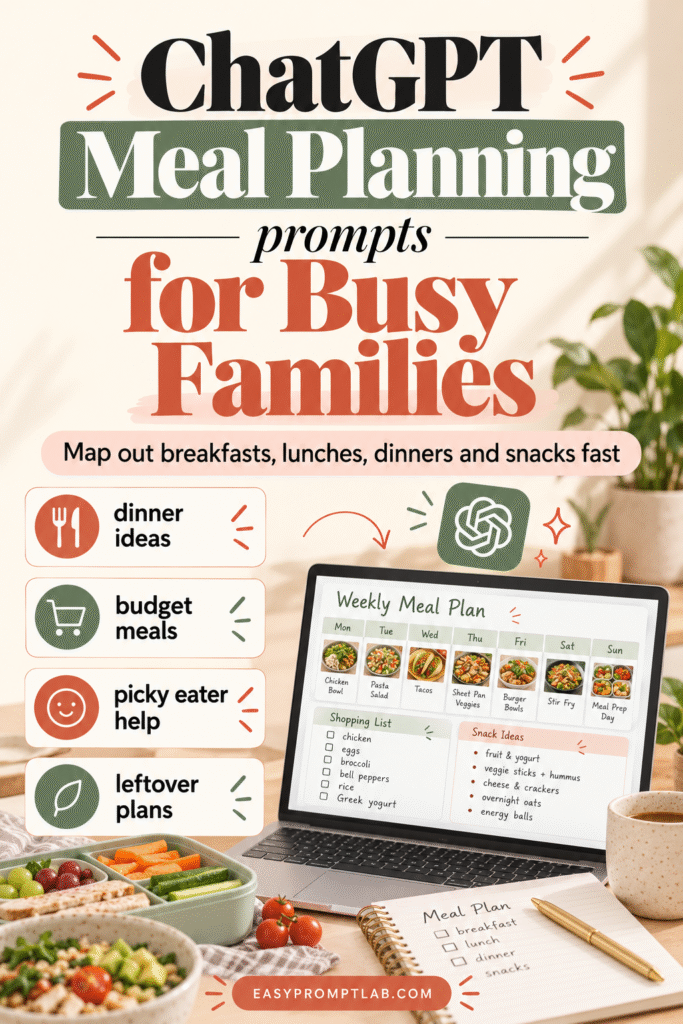
1. Create a realistic weekly dinner plan
Prompt:
Create a seven-day dinner plan for my family using the information below:
[PASTE FAMILY BRIEF]
Requirements:
- match easier meals to our busiest evenings;
- use more involved meals on days when we have more time;
- reuse ingredients across several meals where practical;
- avoid repeating the same main ingredient too often;
- include at least one meal designed to create useful leftovers;
- include realistic preparation and cooking times.
Present the plan as:
Day | Meal | Approximate time | Ingredients reused | Prep I can do earlier
Do not assume that every meal needs to be cooked from scratch.
That final instruction matters.
A useful family plan can include leftovers, freezer meals, sandwiches, jacket potatoes or something extremely unglamorous that gets everyone fed.
Tuesday night does not require a culinary identity crisis.
2. Plan meals around your actual calendar
This is one of the strongest prompts because it combines food with family logistics.
Prompt:
Here is our family schedule for next week:
[PASTE SCHEDULE]
Create a dinner plan around it.
For each day, consider:
- who will be home;
- when people arrive home;
- how much cooking time is realistically available;
- whether anybody needs to eat earlier or later;
- whether food needs to be portable or reheatable.
Label each day:
QUICK
NORMAL
PREP-AHEAD
LEFTOVERSThen recommend an appropriate dinner for each evening.
Do not schedule complicated meals on evenings when the timetable makes them unrealistic.
3. Build a meal plan from food you already have
Prompt:
These are the ingredients currently in my fridge, freezer and cupboards:
[LIST]
Create a family meal plan that uses as many of them as reasonably possible before suggesting additional ingredients.
Prioritise:
- ingredients that need using soon;
- opened packages;
- fresh food;
- freezer/cupboard ingredients.
Tell me:
- what meals I can make;
- which ingredients each meal uses;
- what additional items I need to buy;
- which ingredients are unlikely to be used.
Do not assume an ingredient is safe to eat if I tell you it is expired or questionable.
This is particularly useful before grocery shopping.
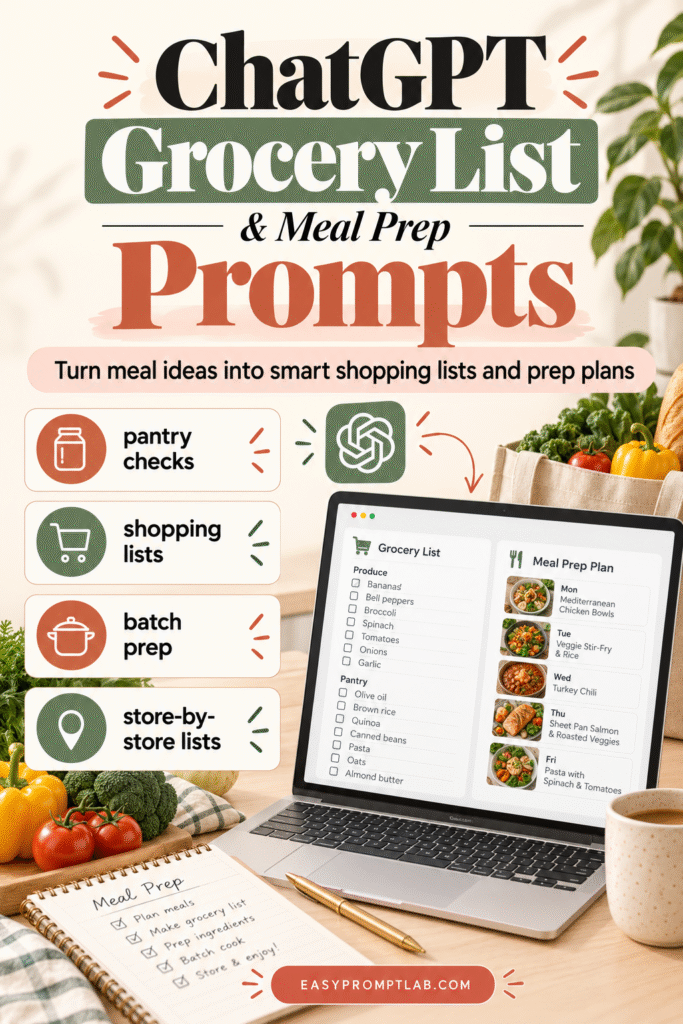
4. Create a grocery list from the weekly meal plan
Prompt:
Here is my meal plan:
[PASTE PLAN]
Here are ingredients I already have:
[LIST]
Create a shopping list containing only what I still need.
Group it by:
- fruit and vegetables;
- meat/fish/protein;
- dairy and chilled;
- bakery;
- tins/jars;
- dry goods;
- frozen;
- household/other.
Where several meals use the same ingredient, combine the quantities.
Flag anything where the required quantity cannot be determined from the information I’ve given.
5. Plan a lower-cost week of family meals
Prompt:
Help me reduce our food spending this week.
Family size:
[NUMBER]Budget:
[BUDGET]Foods we already have:
[LIST]Foods we usually enjoy:
[LIST]Shops available to us:
[OPTIONAL]Create a seven-day meal plan that:
- reuses ingredients;
- makes sensible use of leftovers;
- includes some lower-cost protein options;
- avoids buying ingredients used in only one small quantity;
- keeps preparation realistic.
Do not invent current supermarket prices.
Instead, identify which parts of the plan are likely to be more or less expensive and tell me which prices I should check locally.
The NHS also highlights strategies such as using frozen or tinned fruit and vegetables, batch cooking and using leftovers for lunches as practical ways families may save time and money.
6. Create a week of quick meals
Prompt:
Create seven family dinner ideas where active preparation takes no more than:
[15 / 20 / 30] minutes.
Family preferences:
[LIST]
Ingredients to avoid:
[LIST]
Include a mixture of:
- one-pan meals;
- assembly-style meals;
- batch-cooked options;
- leftover nights;
- genuinely quick cooked meals.
For each meal give:
- ingredients;
- active prep time;
- cooking time;
- what can be prepared in advance.
7. Plan one batch-cooking session for the week
Prompt:
I have [TIME] available on [DAY] for batch preparation.
Here is our meal plan:
[PLAN]
Identify everything I can reasonably prepare during that session.
Organise the work into an efficient order.
Include:
- vegetables to chop;
- sauces or bases to prepare;
- meals that can be cooked ahead;
- ingredients that should NOT be prepared too early;
- items that can be frozen;
- what should be stored separately.
Do not give food-storage safety advice unless it is based on a reliable source. Flag anything that I should verify.
8. Turn dinner leftovers into lunches
Prompt:
Here are this week’s dinners:
[LIST]
Suggest ways to deliberately create leftovers that can become lunches the next day.
For each dinner tell me:
- what extra quantity to make;
- how the leftovers could be repurposed;
- whether the lunch would need anything additional;
- whether it is suitable for taking to work or school.
Avoid suggesting the exact same plate of food every day unless that is genuinely the simplest option.
9. Create a packed-lunch planning system
Prompt:
Help me create a five-day packed-lunch plan.
Person/people:
[AGES/ADULT OR CHILD]
Foods they like:
[LIST]
Foods they will not eat:
[LIST]
Restrictions:
[ALLERGIES / SCHOOL RULES / OTHER]
Available refrigeration:
[YES/NO]
Create a realistic plan with:
- main item;
- fruit/vegetable;
- additional side;
- drink suggestion if appropriate;
- what can be prepared the night before.
Avoid making nutritional or medical claims.
If you’re planning meals for children and want nutritional guidance rather than simple organisation, use an appropriate health source. The NHS recommends a varied, balanced diet and notes that children’s requirements differ by age, particularly for children under two.
10. Plan meals around picky eaters without cooking several dinners
Prompt:
I want to reduce the number of separate meals I cook.
Family meal:
[MEAL]Foods different family members reliably eat:
[LIST BY PERSON]Help me create one flexible base meal with optional components people can add or leave out.
Give me:
- common base;
- optional protein choices;
- optional vegetables/sides;
- sauces/toppings served separately;
- easiest way to prepare everything together.
Do not give feeding therapy or medical advice.
If the eating difficulties described could require professional support, say so.
The goal here isn’t to ask ChatGPT to diagnose “picky eating.”
You’re simply using it to find practical overlap between foods the family already eats.
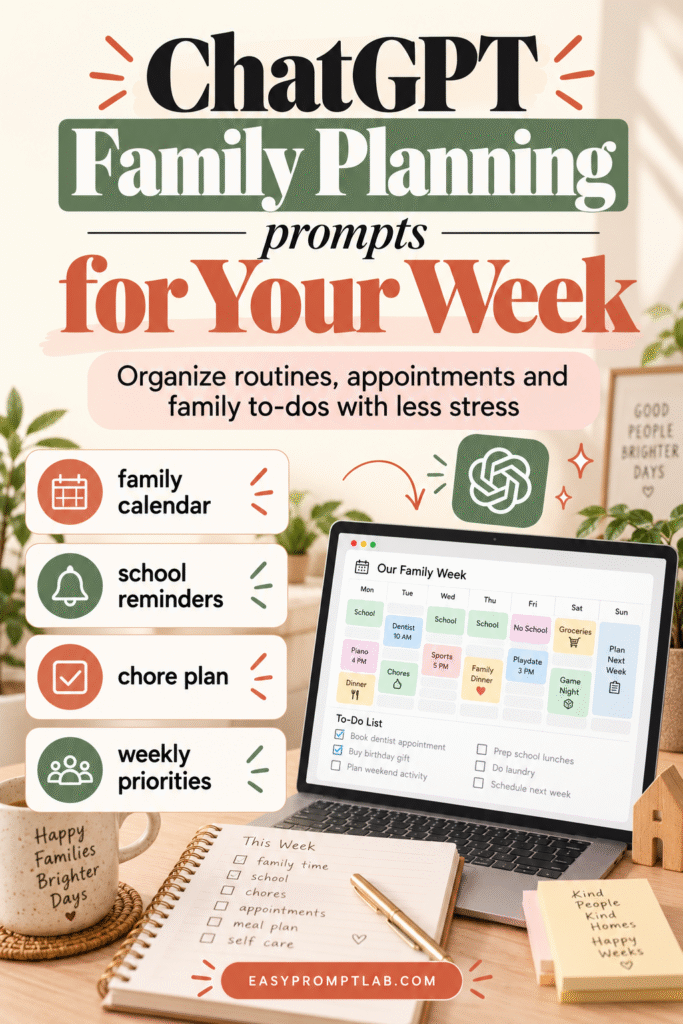
11. Create a family schedule for the week
Now move beyond food.
Prompt:
Turn the following family commitments into a clear weekly plan:
[PASTE SCHOOL / WORK / CLUBS / APPOINTMENTS / EVENTS]
Create a Monday-to-Sunday schedule.
For each day show:
- morning commitments;
- school/work;
- after-school/evening activities;
- meals that need special planning;
- items that need preparing the night before;
- deadlines or reminders.
Highlight any obvious clashes or unusually busy days.
Do not invent travel times or appointment details.
12. Create a Sunday preparation checklist
Prompt:
Based on this week’s schedule:
[PASTE PLAN]
Create a Sunday preparation checklist.
Include only tasks that would meaningfully make the week easier.
Consider:
- food prep;
- school items;
- work items;
- clothes/uniforms;
- appointments;
- paperwork;
- bags;
- charging devices;
- household supplies.
Group tasks into:
10 minutes
30 minutes
60+ minutesPrioritise the highest-impact tasks first.
13. Create a five-minute nightly reset checklist
Prompt:
Create a short evening preparation routine for our household.
Our regular morning responsibilities include:
[LIST]
Our common problems are:
[FORGOTTEN LUNCHES / MISSING SHOES / UNCHARGED DEVICES / ETC.]
Create a checklist that takes no more than 10 minutes on a normal evening.
Include only actions that reduce morning stress.
Keep it short enough that we might realistically continue doing it.
14. Make one weekly family admin list
Family admin has a habit of living in emails, school apps, text messages and the corner of your brain reserved for “things I’m definitely going to forget.”
Prompt:
Here are all the family tasks currently on my mind:
[PASTE MESSY LIST]
Organise them into:
- urgent this week;
- scheduled for later;
- school/children;
- household;
- appointments;
- bills/admin;
- shopping;
- someone else can do this.
Then create a realistic weekly action list.
Do not assign everything to one day.
Highlight anything that has a date or deadline.
15. Create a shared responsibility plan
Prompt:
These are the recurring tasks in our household:
[LIST]
People available to help:
[PEOPLE + AGE/AVAILABILITY WHERE RELEVANT]
Help me create a fair weekly responsibility plan.
Consider:
- time available;
- age-appropriate tasks;
- frequency;
- which tasks must be done at particular times.
Create a simple weekly table.
Do not make assumptions about gender roles or who “normally” does particular household tasks.
16. Plan a particularly busy week
Prompt:
Next week is unusually busy because:
[EXPLAIN]
Here is our schedule:
[SCHEDULE]
Help me simplify the week.
Recommend:
- meals that should be easy;
- tasks that can be done ahead;
- tasks that can safely wait;
- things worth delegating;
- items to prepare the night before;
- days when leftovers/takeaway/simple meals may be more realistic.
My priority is reducing unnecessary workload, not creating a perfect schedule.
17. Build a recurring weekly template
Prompt:
Our weeks are fairly repetitive.
Regular commitments:
[LIST]
Regular meal needs:
[LIST]
Regular household tasks:
[LIST]
Create a reusable Monday-to-Sunday family planning template.
Include spaces for:
- dinner;
- appointments;
- school/work events;
- prep needed;
- shopping;
- household jobs;
- reminders.
Keep the template simple enough to reuse every week.
18. Plan around one grocery shop per week
Prompt:
I want to reduce extra grocery trips.
Create a weekly food-planning system based around one main shop.
Consider:
- which fresh ingredients should be used earlier in the week;
- which freezer/cupboard meals work later;
- leftovers;
- lunches;
- emergency backup meals.
Give me a suggested order for the week’s meals and explain the logic.
Do not provide food-safety assumptions about specific ingredients unless verified.
19. Create two emergency meals for chaotic nights
Prompt:
Help me choose two emergency family meals I can keep ingredients available for.
Requirements:
- minimal preparation;
- mostly freezer or cupboard ingredients;
- ingredients with reasonable storage life;
- acceptable to my family;
- faster than ordering takeaway.
Foods we like:
[LIST]
Suggest five options, then identify the two simplest.
Having emergency meals is not admitting defeat.
It is acknowledging the existence of Thursdays.
20. Run a weekly review before planning the next one
Prompt:
Help me review last week’s family plan.
Planned meals:
[LIST]What we actually ate:
[LIST]Food wasted:
[LIST]Meals everyone liked:
[LIST]Meals that were difficult:
[LIST]Schedule problems:
[LIST]Unexpected events:
[LIST]Analyse:
- what worked;
- what created unnecessary effort;
- ingredients we repeatedly wasted;
- meals worth repeating;
- which days need simpler plans.
Then give me five specific changes to make next week.
ChatGPT gets better when you tell it what your week actually looks like
Compare:
Give me a healthy weekly meal plan for a family of four.
with:
We are a family of four. Monday and Wednesday we get home after 7pm, Tuesday one child needs dinner at 5pm before an activity, Friday is usually a relaxed evening, and I have chicken, peppers, potatoes and frozen peas that need using. Plan seven dinners and reuse ingredients where sensible.
The second prompt gives ChatGPT something much closer to a real planning problem.
OpenAI’s current prompting guidance explicitly recommends adding the context that can change the answer and describing what a useful output should look like.
Don’t ask ChatGPT to decide what your family “should” eat
There’s an important difference between:
Organise meals using these foods and restrictions.
and:
Tell me exactly what my child should eat to fix their nutritional problem.
The first is planning.
The second may require qualified health advice.
For general healthy eating, the NHS recommends eating a variety of foods from the main food groups and includes fruit and vegetables as an important part of a balanced diet. Its family recipe service also provides meal ideas developed with nutritionists.
If a child has allergies, significant dietary restrictions, feeding difficulties, growth concerns or another medical issue, don’t use an AI-generated meal plan as a substitute for appropriate professional advice.
Tell ChatGPT your real constraints
Useful constraints might include:
- £80 weekly budget;
- no more than 20 minutes active cooking;
- one vegetarian family member;
- one evening where everybody eats separately;
- no oven on Tuesdays;
- use the freezer first;
- lunches must be portable;
- nobody wants leftovers more than once.
Constraints usually improve the plan rather than limiting it.
Without them, ChatGPT may enthusiastically plan seven impressive dinners for a family that wanted to spend as little time in the kitchen as humanly possible.
Don’t ask for seven completely different meals if you want an easier week
Variety sounds appealing.
It can also produce:
- seven separate ingredient lists;
- half-used packets;
- increased cost;
- more food waste;
- more preparation.
Instead, tell ChatGPT to deliberately reuse ingredients.
For example:
Monday: roast chicken and vegetables
Tuesday: chicken wraps
Wednesday: pasta using remaining vegetables
Thursday: freezer meal
Friday: homemade pizza using remaining toppings
The objective isn’t novelty.
It’s making the whole week work.
Ask ChatGPT for options, not commandments
If the first meal plan doesn’t look realistic, don’t start over.
Say:
Wednesday is too complicated. Replace it with something that takes 15 minutes.
or:
My children won’t eat that. Give me three alternatives using the same ingredients.
OpenAI recommends iterative refinement: review the initial response, then add context or adjust the request rather than expecting the first prompt to be perfect.
A simple weekly ChatGPT family-planning routine
You can make the whole process fairly quick.
Step 1: Check the calendar
List:
- work;
- school;
- activities;
- appointments;
- unusual commitments.
Step 2: Check your kitchen
Write down food that should be used first.
Step 3: Plan dinners
Match meal effort to the actual timetable.
Step 4: Generate the grocery list
Subtract what you already own.
Step 5: Identify prep tasks
Choose only preparation that will genuinely save time.
Step 6: Create the family admin list
Add forms, appointments, school items and other deadlines.
Step 7: Review at the end of the week
Keep what worked.
Change what didn’t.
Your weekly plan does not need to look impressive.
It needs to survive contact with Wednesday.
Frequently asked questions
Can ChatGPT create a weekly family meal plan?
Yes.
It can organise meal ideas around family size, preferences, schedule, budget and ingredients you already have.
The more specific the context you provide, the more useful the plan is likely to be.
What should I tell ChatGPT when planning meals?
Useful information includes:
- number of people;
- ages where relevant;
- food preferences;
- allergies or restrictions;
- budget;
- cooking time;
- weekly schedule;
- ingredients you already own;
- appliances available;
- leftovers you’re willing to eat.
Can ChatGPT create a grocery list from my meal plan?
Yes.
Give it the planned meals and a list of ingredients you already have, then ask it to consolidate the remaining ingredients by supermarket section.
Check quantities before shopping.
Can ChatGPT help reduce food waste?
It can help identify ways to reuse ingredients, plan leftovers and prioritise food already in your kitchen.
The quality of the result depends on the information you give it.
Can ChatGPT plan meals for children?
It can help organise ordinary family meals and preferences.
For specific nutritional requirements, allergies, feeding difficulties or health concerns, rely on appropriate professional advice rather than an AI-generated plan.
Can ChatGPT organise my entire family week?
Yes, particularly if you give it the schedule and ask it to combine meals, appointments, activities, preparation and reminders into one weekly view.
That is often more useful than using it only as a recipe generator.
Use ChatGPT to reduce decisions, not create more of them
A weekly family plan does not need 14 dinner options, three alternative grocery lists and an elegant spreadsheet with seventeen categories.
It needs to answer a few practical questions:
What are we eating?
What do I need to buy?
Which nights are going to be hectic?
What needs preparing beforehand?
What am I likely to forget?
Give ChatGPT your real schedule, actual food preferences and genuine constraints.
Then use it to turn all that scattered information into one workable plan.
That is where it becomes useful.
Not as the person running your household.
Just as the assistant that helps you stop carrying quite so much of the weekly plan in your head.