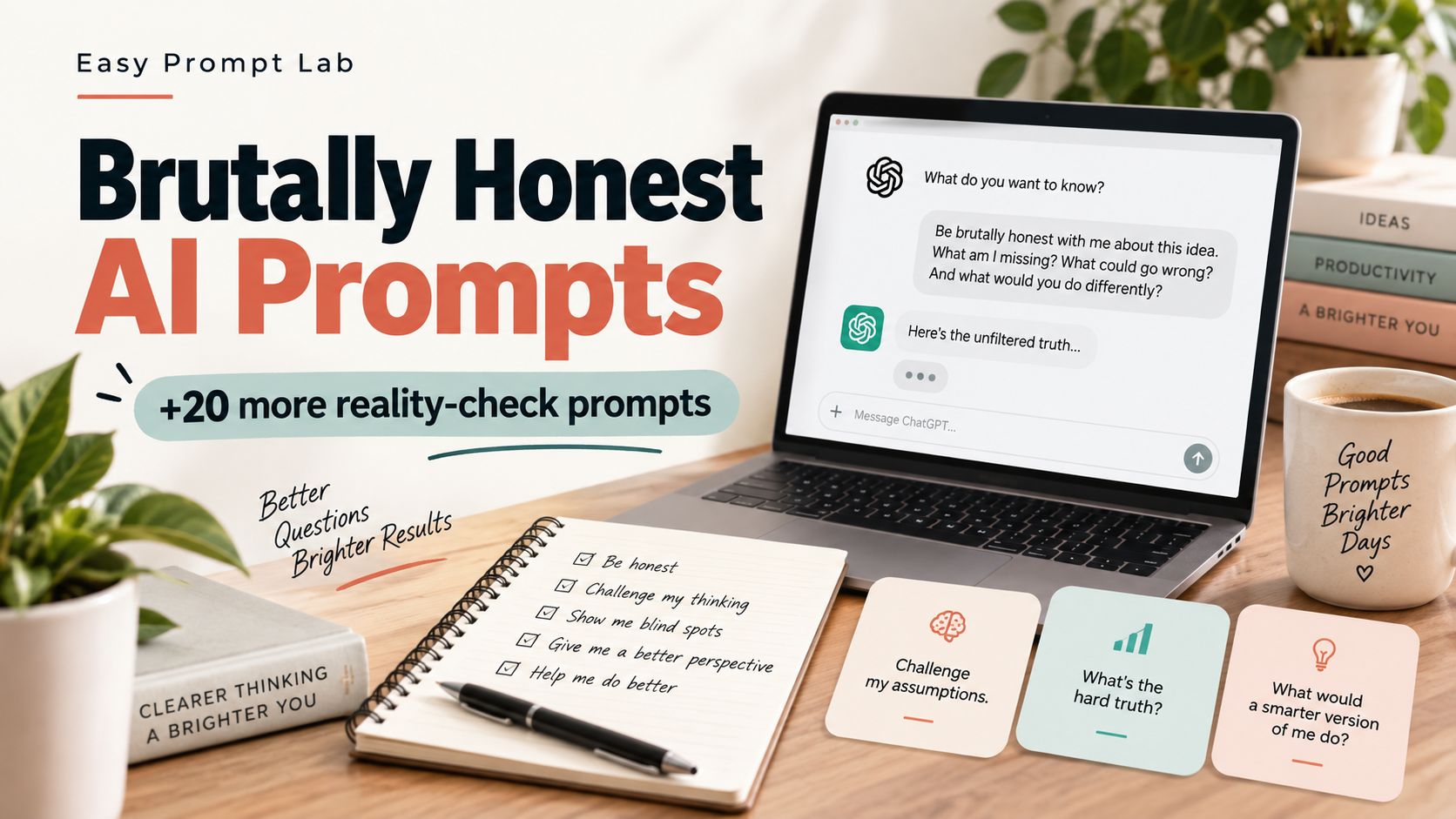
The Brutally Honest AI Prompt Everyone’s Suddenly Using (+ 20 More Reality Check Prompts)
You’ve probably seen it already. A screenshot floating around, someone posting “I asked ChatGPT to stop being nice to me and it actually humbled me” with a wall of text underneath that reads less like a chatbot and more like the friend who finally says the thing everyone’s been thinking.
READ: 31 ChatGPT Prompts Return to Work Moms Can Copy and Paste to Feel More Confident
That’s not an accident. It’s a real, specific shift in how people are using AI, away from “help me write this” and toward “tell me what I don’t want to hear.” And it’s spreading because it works. Most AI tools are trained to be agreeable by default. They soften things. They validate first, critique second, if at all. This whole trend is just people figuring out how to turn that off on purpose.
Here’s the prompt everyone’s sharing, why it works and 20 more built on the same idea for different parts of your life.

The original viral prompt
Stop being agreeable. I don’t want encouragement, I want the truth. Based on everything I’m about to tell you, give me a brutally honest, no-cushioning assessment. Don’t soften it, don’t add a silver lining, don’t end with something nice. Just tell me what you actually see. Here’s my situation: [describe your situation]
Why this works: most of the instruction isn’t about the topic, it’s about explicitly overriding the AI’s default politeness. Naming the behavior you don’t want (“no cushioning,” “don’t add a silver lining”) is what actually changes the output. Vague requests like “be honest” rarely work as well, because “honest” is exactly what a people-pleasing model thinks it’s already being.
How to use these prompts
Same rule as always: paste into ChatGPT, Claude, or Gemini, swap in your real details, and don’t be precious about it. The whole point is discomfort on purpose. If a response still feels too soft, reply with “still too nice, push harder” and it usually will.
One honest caveat before you dive in: this is a genuinely useful exercise for pattern-spotting and self-reflection, but it’s still a language model pattern-matching on what you typed, not an oracle. Treat sharp feedback as a prompt to think harder, not gospel.
Reality Checks on Your Habits and Choices
1. The life-audit version
Based on how I’ve described my daily routine, be honest about what patterns are actually holding me back versus what I just tell myself is holding me back. Here’s my day: [describe it]
2. Spending habits, no sugarcoating
Look at this list of what I spent money on this month and tell me honestly what it reveals about my priorities, not what I think it should reveal. [paste spending categories/amounts]
3. The “am I making excuses” check
I keep saying I want to [goal], but here’s what’s actually happened over the last [timeframe]: [describe]. Be honest, is this a real obstacle or am I making excuses?
4. Time audit
Here’s roughly how I spent my time this week: [describe]. Tell me honestly what this says about what I actually value versus what I claim to value.
Reality Checks on Work and Career
5. Resume/CV, unfiltered
Review this resume like a skeptical hiring manager who’s seen a thousand of these. Don’t tell me it’s good, tell me what’s actually weak, generic, or unconvincing. [paste resume]
6. The “am I actually ready for this” check
I’m considering [career move/promotion/job change]. Based on what I’m about to tell you about my experience, be honest about whether I’m actually ready or whether I’m underestimating the gap. [describe your situation]
7. Email/message tone check
Read this message I’m about to send and tell me honestly how it will actually land, not how I intend it to land. [paste message]
8. Performance self-review, minus the ego
Here’s how I’d describe my performance this year: [describe]. Push back on anything that sounds like I’m being generous with myself.
Reality Checks on Relationships and Communication
9. Conflict pattern-spotter
Here’s what happened in a recent disagreement with [person]: [describe both sides as fairly as you can]. Be honest about where I contributed to the problem, not just where they did.
10. The “am I the problem” check
Describe a repeated pattern I keep running into with people: [describe]. Be honest about what my role in this pattern might be.
11. Text message reality check
Here’s a text conversation: [paste, removing anything identifying]. Be honest about how this reads from the outside, not how I meant it.
Reality Checks on Goals and Plans
12. The “is this plan actually realistic” check
Here’s my plan to [goal] by [timeframe]: [describe]. Be honest about whether this is realistic or whether I’m being overly optimistic about time, effort, or difficulty.
13. Business/side-hustle idea, unfiltered
Here’s my idea for [business/project]: [describe]. Don’t be encouraging, be honest about the actual weaknesses in this idea and who’s already doing it better.
14. The “why isn’t this working yet” check
I’ve been trying to [goal] for [timeframe] without much progress. Here’s what I’ve actually been doing: [describe]. Be honest about what’s likely the real blocker.
15. Content/creative work critique
Critique this like an editor who doesn’t care about my feelings, only about making the work better. [paste writing, caption, script, etc.]
Reality Checks on Mindset
16. The comfort-zone check
Here’s something I say I want but haven’t pursued: [describe]. Be honest about whether fear, laziness, or genuine bad timing is the real reason.
17. Self-talk audit
Here’s how I typically talk to myself when I make a mistake: [describe/give an example]. Be honest about whether this self-talk is actually helping me improve or just making me feel bad without changing anything.
18. The “what would an outsider say” check
If a completely neutral stranger watched a week of my life, what pattern would they notice about me that I probably don’t see myself? Here’s a rundown of my week: [describe]
19. Decision-avoidance check
I’ve been going back and forth on this decision for a while: [describe]. Be honest about whether I actually need more information, or whether I already know the answer and am avoiding it.
20. The unfiltered pep-talk reversal
Instead of motivating me, tell me honestly what’s realistic to expect if I keep going exactly as I am right now, no changes. Here’s what “as I am right now” looks like: [describe]
A quick note on using this well
The viral appeal is the discomfort but the actual value is in what you do after reading it. A sharp, unfiltered response is only useful if you sit with it for a second instead of either dismissing it or spiraling on it. Use it as a starting point for a real decision, not a verdict.
If you liked this format, the Prompts and AI Prompt Engineering categories have more prompts built the same way, ones that push past the AI’s default politeness to get you something you can actually use.